

When to Hold ‘Em and When to Fold ‘Em
Welcome to issue #3 of The Davem Dish. Every two weeks I share what actually works in investing based on my 20 years of wins, losses and expensive lessons. You’ll also get my thoughts on solopreneurship and life in general because the same principles apply — keep it simple, stay consistent and focus on what matters.
Welcome to The Davem Dish where I guarantee you a 50% return on your investment in XYZ company (that you never heard of) in just 6 months. Wire me your life savings today!
Just kidding.
It amazes me how people still fall for these obvious scams. The only guaranteed return comes from T-bills. Everything else involves some level of risk and those ‘too good to be true’ promises are exactly that — too good to be true.
Case in point, a recent headline from the WSJ “Obscure Chinese Stock Scams Dupe American Investors by the Thousands”. Classic pump and dump scheme. Scammers acquired shares in tiny companies, flooded social media with fake hype about “the next big thing”, watched naive investors bid up the price and then cashed out leaving the naive investors with huge losses.
You, as an experienced investor, wouldn’t fall for that, right?
What about another, subtler, scam. Investor forums are littered with headlines like “XYZ stock is the buy of the year”. The post follows a predictable, boring script about how a new product, shifting market dynamics and visionary, capable management are going to lead this company to greatness, yada yada.
I get it, clickbait works. But why are we even wasting time on this fluff when the only things that actually matter is quantifiable results and current valuation.
Successful investing isn’t about stories or promises. It’s about monitoring companies that consistently deliver financial results that meet or exceed expectations. Not just talking about doing things — actually doing them. And based on our analysis, currently undervalued and trading at a price where we can earn at least our minimum required return.
This opportunity may only be available for a day.
A simple but important distinction. There are a lot of good companies out there, but they are only good investments at the right price.
Think about real estate. If you buy a beautiful beachfront house planning to flip it in a few years for a 30% profit and a hurricane inflicts heavy damage the next week, well then guess what? You may still earn that profit someday but not likely in a few years.
Every stock investment headline should read, “XYZ stock is a buy at this price based on my analysis as of this date”. Not as catchy, sure, but haven’t we evolved past falling for cheap marketing tricks?
So, when exactly is the right time to buy a stock and when is it time to sell?
Let’s dive in.
When Is the Right Time to Buy … and to Sell?
One of the hot companies of recent years is NVIDIA ($NVDA). The leader in the AI chip market. A darling tech stock. A member of the Magnificent Seven.
If you bought only three years ago, you’re sitting on an 851% unrealized gain. Congratulations — you’ve earned bragging rights for life.
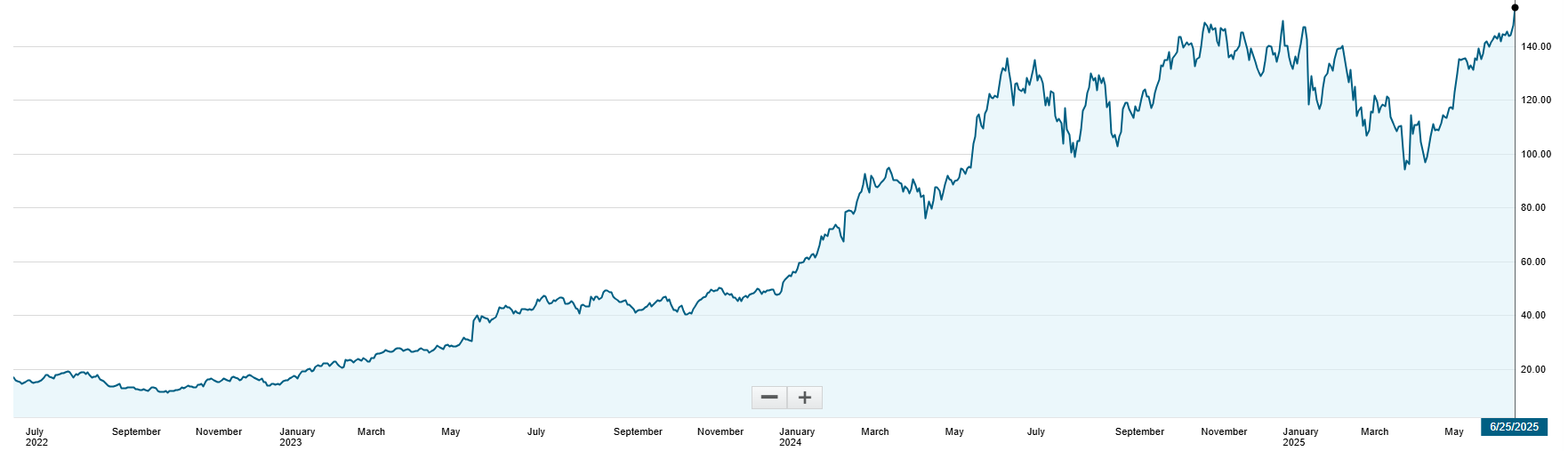
I currently own shares with a 58% gain. Not bad for a two-month holding period. Now I’m facing a classic dilemma … should I sell?
The stock is at an all-time high and a lot of the headlines are negative:
“‘Why Am I Doing This?’ These Investors Are Locking In Stock Gains While They Can.”
“Ordinary Investors Are Souring on Big Tech”
“AI Companies Should Be Wary of Gulf Spending Spree”
“NVDA Discloses More China Risks”
“Citic Securities Adjusts NVDA Price Target Down From $165 to $145”
Plus, some troubling fundamentals. NVDA missed last quarter's estimates with “only” 27% earnings growth compared to the prior year and an almost 20% drop in operating margin.
Uh oh, growth is slowing.
Then there’s the chart pattern. It looks eerily similar to Cisco during the dot-com boom. Today Cisco’s stock still trades below its peak from 25 years ago. [Read more about when Buy and Hold doesn’t work here]
Is AI just another bubble?
I should just sell now at the peak and take my profit.
Hold on, let's think this through.
In the simplest terms, stock prices for quality companies reflect current earnings and more importantly, future expected earnings. Which means the most important metric to follow is … earnings growth.
What defines a quality company? Check out my free guide Stock Selection Simplified to learn more.
NVDA has delivered phenomenal annual earnings growth, close to or above 100% for the past five, three and one-year periods. Will this continue for the next five to ten year period? Probably not, but future annual 25% growth may be achievable.
Using this estimated growth rate along with a reasonable future PE multiple and our minimum 15% ROI will allow us to determine what a fair value price is today.
Spoiler alert — the fair value is still above the current price.
Does this mean I’m buying more? No. I won’t add to a position at an all-time high but I’m also not selling (yet).
The best way to let winners run without letting them become losers is by using trailing stop orders. This allows you to mitigate risk and takes the ego, emotion and bias out of selling.
I learned the hard way. I routinely sold winners too quickly because I didn’t want my profit to slip away, a common behavior known as the disposition effect.
Here’s an example:
Back in August 2011, MercadoLibre ($MELI) met my criteria, so I invested at $60 per share. Just one week later, I had already earned my minimum 15% return. But I got nervous about losing the profit and sold.
The stock kept climbing to what was then an all time high of $445 in March 2018.
If I’d followed the selling rules I use today, a trailing stop would have been triggered at $334 in May 2018 — a 457% total return.
And this was just the first of what turned out to be many opportunities to invest in MELI in subsequent years.
Trailing stops “systemitize” the selling process. All the media noise and contradictory signals can be ignored. And your inner noise (ego, emotion, and biases) can also be ignored.
This is a simple yet important piece to successful investing. Rely on systems, not emotions, to know when to hold 'em and when to fold ‘em.
Where does NVDA go from here? I don’t know and neither does anyone else. I can reasonably infer the share price will continue to gain as long as the company keeps growing and meeting expectations. If it doesn’t and drops enough to trigger my trailing stop order, I’ll happily take at least my minimum 15% return and move on to the next opportunity …
Which could be NVDA again at the right price.
Davem Watchlist Insights
Nearly 40% of the 36 companies I follow are currently overvalued. One undervalued company I’m watching closely is Arista Networks ($ANET). Last week the stock dropped to a buy level at $85 but I missed it. It’s since jumped 14% to $98.
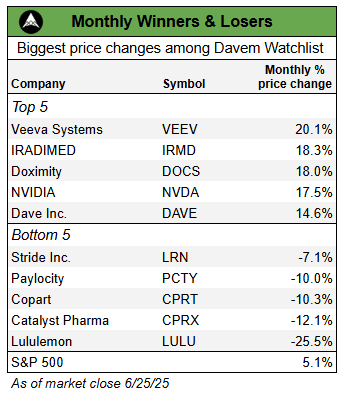
Let’s look at monthly performance:
1% Better
You’ve likely heard the phrase “1% better every day”. Choose one thing to improve slightly each day. Initially the changes will appear minimal but over time, the daily improvements will accumulate to a big change.
I like the concept. Simple and actionable.
Here’s how I apply the concept to writing The Davem Dish. I pull an idea from my years of investing experience. Start with an outline and each subsequent day add more detail and refine it. Then I have Claude review it.
Yes, you read that right, I admit to using AI. I don’t have Claude come up with ideas and write for me. I don’t take its output word for word. I do the work and use Claude as an editing tool to be more efficient.
If you’re not using AI to help you, you’re doing yourself a disservice.
It’s like a traveler insisting on paper maps because Google Maps is “cheating.” So you have a stack of paper maps in your car that you have to spend time studying before you go anywhere, then trying to reference them while driving and, oh by the way, the paper map doesn’t update real time traffic conditions and is outdated, so it isn’t going to show where your friend's new subdivision is anyway.
Does that make sense, when Google Maps shows you exactly where to go in seconds and adapts in real time? It’s just a more efficient use of your time and energy.
Anyway, back to 1% better. Just because I’m aiming to be better each day, doesn’t mean I’m layering in more complexity, in fact, I’m trying to further simplify how I communicate concepts.
And when your daily improvements create a big change in one area and you start seeing diminishing returns? Easy, apply the same principle to another area of your life.
The possibilities are infinite. You’ll never run out in your lifetime.
Where can you apply the 1% better principle today?
Cheers,
Andrew
Thanks for reading The Davem Dish! If you enjoyed this issue, feel free to subscribe and share it with other awesome people like you.
The content provided are personal opinions and presented for educational purposes only, as of the date published or indicated. Davem Advisors LLC is not a bank, licensed securities dealer, broker or investment advisor. Displayed returns are unaudited. Nothing stated constitutes a recommendation or advice as to whether any investment is suitable for a particular investor. You alone are solely responsible for determining whether any investment, strategy or service is appropriate for your objectives. Past performance is no guarantee of future results. Inherent in any investment is the risk of loss.