

Invest In What You Know
Welcome to issue #4 of The Davem Dish. Every two weeks I share what actually works in investing based on my 20 years of wins, losses and expensive lessons. You’ll also get my thoughts on solopreneurship and life in general because the same principles apply — keep it simple, stay consistent and focus on what matters.
You’ve likely heard how real estate investing is the way to go to build wealth. Plenty of tips and tricks from social media experts on how to build your own empire.
Everybody has also heard the importance of consistency and to follow your passion.
If your passion is real estate — maybe you’re a licensed agent, enjoy project management and love remodeling houses then you should pursue real estate investing.
I don’t have any interest in dealing with contractors or becoming a landlord. So, does it make sense for me to put time and effort into real estate investing? Nope, I’ll never love it and want to do the work day in and out to be successful.
Maybe you love vintage watches. Same principle. If you love scouring the market for undervalued Rolexes, know the watch market inside and out then by all means turn that passion into profit.
You can make money in most any pursuit. But the only way it’s going to be sustainable is if you love the work. You will never be consistent and persistent otherwise. If you're forced to do something you hate every day, you will become resentful, and your mental health will suffer. That’s basic human psychology.
I enjoy investing in stocks. Valuing companies, monitoring performance, buying and selling. The whole process energizes me. Not just in bull markets when everything feels easy, but in all markets. Even when I lose money, I don’t throw in the towel because I enjoy the process.
That’s how I can be consistent with doing the necessary work for successful investing.
And what is the “work”? It starts with finding quality companies.
The Only Numbers that Actually Matter
The Davem Method is a data driven approach. I don’t really care who runs the company, macro trends or anything else that is supposedly driving the market. I care only about the numbers, because as the old saying goes, “numbers don’t lie”.
Well, they can be massaged, which is why I track several key metrics:
Earnings Growth
Sales Growth
Free Cash Flow
Return on Equity
Equity Growth
Return on Invested Capital
Expanding Margins
Since stock prices reflect current earnings and future expected earnings then earnings growth is the most important metric to follow, but earnings cannot consistently grow without sales growth.
Let me repeat that. Earnings will not grow over the long term without sales growth.
Sure, in the short-term companies have mechanisms to maintain earnings without growing sales but in the long run it can’t happen. So, sales growth is a close second as the most important metric to follow.
When sales are generated, quality companies do what you should with your personal finances — control spending to retain as much cash as possible. If done well, operating margins and the bottom line will expand.
Checking margins can also be an easy way to spot what I call “financial engineering”. If earnings increase but operating margins tank, something is wrong with business operations — a red flag.
It’s important that the cash retained and invested is actually creating value. That’s where Return on Equity (ROE) and Return Invested Capital (ROIC) come in. Is the company consistently making smart investments that in turn will generate additional sales and earnings growth.
Make money → Keep money → Invest money → Make more money
This simplifies the process and eliminates noise. You don’t have to keep track of every metric under the sun or parse opinions on what might happen to the business. All you need to monitor is the metrics that matter.
Why does this work? Companies that perform well on these metrics are rewarded in two ways:
1 - They are valued by the market, meaning the share price will increase
2 - Other companies value their financial strength, making them attractive takeover targets.
A consistent track record of performance also lets us make reasonable assumptions about future success and shows the company is well-run by the current management team. I don’t need puff pieces about visionary CEOs with skin in the game. All that matters is if the company hits the numbers consistently.
This doesn’t mean growth follows a straight line up. There will be business fluctuations and all companies will stumble.
But I follow quality companies, not turnarounds so stumbles can only be short lived — no more than two consecutive quarters of not meeting the Davem criteria.
Ultimately, the goal is to be approximately correct with our analysis to invest in quality companies at attractive prices, while balancing the opportunity cost of not investing in companies with significant upside potential.
So judgment calls are made based on experience. This is not an exact science and no company perfectly meets all the criteria. But when you focus on the metrics that actually drive stock prices you can invest with discipline instead of “buy and hope”.
Want to learn more specifics about the Davem Method? Check out my free guide Stock Selection Simplified.
Davem Watchlist Insights
The S&P 500 is near an all-time high and nearly a third of the watchlist companies are at 52 week highs. Buying opportunities are scarce. But as Liberation Day proved, markets can shift quickly.
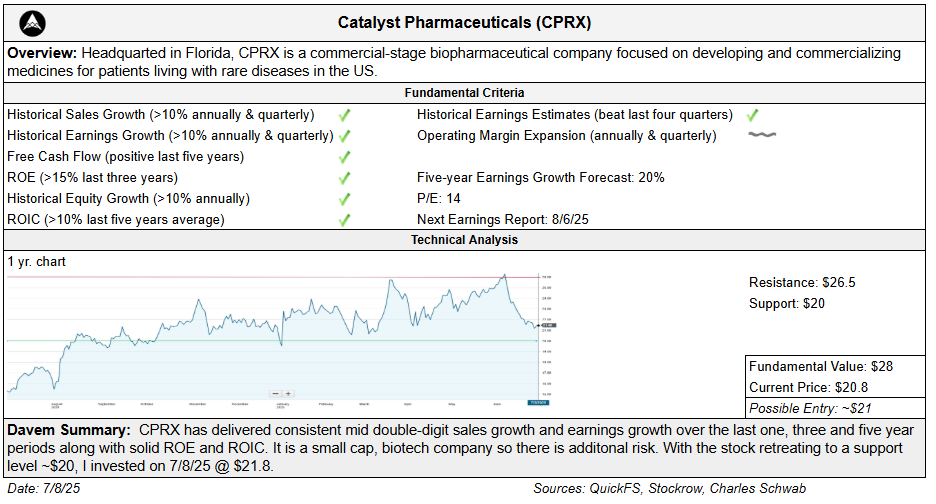
One company I was watching closely last week was Catalyst Pharmaceuticals ($CPRX) . Check out the snapshot below and tell me what you think.
Tech Stocks at Peak Flow
When Colorado rivers hit peak flow in June the water rises so high that massive boulders disappear beneath the surface. Beginners can float down Class V rapids looking like experts. Everyone’s a genius at 6,000 CFS.
That’s tech stocks right now.
AI companies with no revenue are worth billions and every speculative tech bet is working. The water’s so high, the boulders don’t matter … yet.
But I’ve rafted these same rivers at non-peak flow. Those submerged boulders? They become obstacles. The novices who were geniuses last month? They’re swimming for shore or wrapped around rocks.
Here’s what most investors don’t understand — the danger isn’t when you can see the boulders, it’s right now, when you can’t.
At peak flow, you’re moving too fast to scout hazards. Too confident and successful to think you need an exit plan.
Then the water drops. Even just 20% and suddenly:
The hidden boulders appear
The easy channels vanish
Half the boats pile up on the same rock
The real nightmare? If a landslide created an instant dam. In rafting, everyone crashes into each other trying to escape. In markets, everyone crashes the exits trying to sell.
I can’t tell you when tech’s water level drops. Nobody can. Maybe it will be next month, maybe it will be 2027.
But what I can control is planning my exit points while the water’s high. Set my stops above the boulders and know exactly where the shore is.
The best rafters aren’t the ones who predict water levels. They’re the ones who navigate the river at almost any level.
Same with tech stocks. Ride the high water and make your money. But plan exactly where your exit is before everyone else tries to get out at the same time.
Cheers,
Andrew
Thanks for reading The Davem Dish! If you enjoyed this issue, feel free to subscribe and share it with other awesome people like you.
The content provided are personal opinions and presented for educational purposes only, as of the date published or indicated. Davem Advisors LLC is not a bank, licensed securities dealer, broker or investment advisor. Displayed returns are unaudited. Nothing stated constitutes a recommendation or advice as to whether any investment is suitable for a particular investor. You alone are solely responsible for determining whether any investment, strategy or service is appropriate for your objectives. Past performance is no guarantee of future results. Inherent in any investment is the risk of loss.