

Buy and Hold Doesn’t Work
Welcome to issue #2 of The Davem Dish. Every two weeks I share what actually works in investing based on my 20 years of wins, losses and expensive lessons. You’ll also get my thoughts on solopreneurship and life in general because the same principles apply — keep it simple, stay consistent and focus on what matters.
There’s a fictional story that perfectly captures what separates expertise from effort.
A malfunction at a nuclear power plant was slowing generation and reducing efficiency. The plant’s engineers spent months trying to figure out the problem. Eventually, they hired one of the top nuclear engineering consultants to assess the issue. For the next several hours, the consultant looked around every little detail of the plant — the hundreds of dials and gauges, taking notes and making calculations.
After nearly a full day’s work, the consultant grabbed a marker, climbed up a ladder and put a big “X” on one of the gauges. “This is the problem”, said the consultant, pointing to the big X. “Replace this and everything will be back to functioning properly”. The consultant then left and flew home.
Later that day, the plant manager received an email from the consultant’s assistant with an invoice for $50,000. Despite the fact that this problem was costing the plant hundreds of thousands of dollars every week, the manager was shocked by the fee. He replied to the assistant, “How is it possible for less than a day’s work to be valued at $50,000? All he did was write an X with a marker.”
The assistant replied, “$1 for the X, and $49,999 for knowing where to put the X.”
We’re drowning in financial noise. Every day brings fresh “breaking news”, hot tips, new schemes and contradictory opinions. This leads to analysis paralysis and makes it harder to make decisions.
But here’s what I’ve learned from nearly two decades of investing and refining the Davem Method. Success doesn’t come from processing more information and following more complex systems. It’s about knowing what information actually matters.
With the Davem Dish, I won’t just teach you a simple, proven investment process. I’ll show you where to focus your attention for the best opportunities at any given time.
In other words, I’ll show you where to put the X.
Now, let’s dive into this week's issue.
Is Buy and Hold the Best Strategy?
Buy and Hold is one of the golden rules of investing advice. Find a good company, with good management, buy shares and check back 30 years later when you are rich. Ask any sixth grader what they know about investing and they’ll probably say, ‘Buy and Hold’.
For index fund investors, this is a fine strategy. But what if you’re picking individual stocks? Is Buy and Hold the best strategy?
Let’s step through a case study:
A high-flyer of the dot-com days was Cisco ($CSCO). In March 2000, CSCO became the world’s most valuable company. Their routers and hardware were building the backbone of this new, great thing called the Internet and the stock hit an all-time high of $80. John Chambers was a well-respected CEO, who held the top job for 20 years — practically forever in CEO terms. From 2000 to 2015, the company more than doubled sales from $19 billion to $49 billion.
Checked the boxes. Good company, good management.
How did the stock do during those 15 years? If you bought near the peak in July 2000 at $65 and held until Chambers stepped down in July 2015 you watched the stock price shrink to $27. That’s a total return of -58.5%. Average annual return -5.7%. Not very good.
Ok, you might argue this data is skewed by the dot-com crash. So, let's take a look then on how the stock fared from 2005 to 2015. During this decade, CSCO mostly traded in a range from $15 to $30. That’s easy math, a 100% total return or about 7% annually. Better than losing money, but still lagging the S&P 500’s historical average.
Instead of Buy and Hold, what if you used the Davem Method?
If our analysis indicated that CSCO continued to meet our quality criteria and was undervalued, we would look at support levels as investment opportunities. How would that have played out?
Three examples:
Investment #1:
2/9/2009 Buy: $14.5 (support level)
5/24/2010 Sell $22.6 (trailing stop triggered)
56% gain in 15 months
----------------------------------------------------------------------
Investment #2:
8/15/2011 Buy: $14.5 (support level)
4/30/2012 Sell: $17.2 (trailing stop triggered)
19% gain in 8 months
----------------------------------------------------------------------
Investment #3:
7/16/2012 Buy: $15 (support level)
10/28/2013 Sell: $21.3 (trailing stop triggered)
42% gain in 15 months
----------------------------------------------------------------------
All short-term. And all significantly better than the 7% annual Buy and Hold return and the S&P 500 historical average.
In a perfect world, our initial investments will become tenbaggers and we’ll get to brag to all our friends about how smart we are. Yes, this does happen but remember it’s an exception and shouldn’t be counted on.
Oh ok, this looks like market timing and nobody can do that consistently, you might be thinking.
We’re not trying to time the market. We’re not going to sell just because a stock is trading at a 52 week high or a recent resistance level or when some famous money manager says it’s time to sell or when we get nervous and want to lock in a profit.
We’re following a simple process to:
Find quality companies
Wait until they are undervalued and trading at an attractive price to earn at least our minimum return
Systematically selling when (if) the share price moves against us
Does this approach take a little time and effort? Yes, but probably less than the amount of time you spend daily scrolling social media.
Is it difficult? Not really. You mostly just need to be consistent.
Can you do this yourself and earn above market returns? Absolutely.
Will one of today’s high-fllyers NVIDIA ($NVDA) be the next CSCO? I’ll provide my take in next week’s issue.
Want to learn more specifics about the Davem Method? Check out my free guide Stock Selection Simplified.
Davem Watchlist Insights
Synopsys ($SNPS) was added to the watchlist last week. The analysis? About thirty minutes or as long it takes to pick up Starbucks.
It’s not about cutting corners but rather keeping it simple and focusing on what matters. Take a look at the snapshot below and let me know what you think.
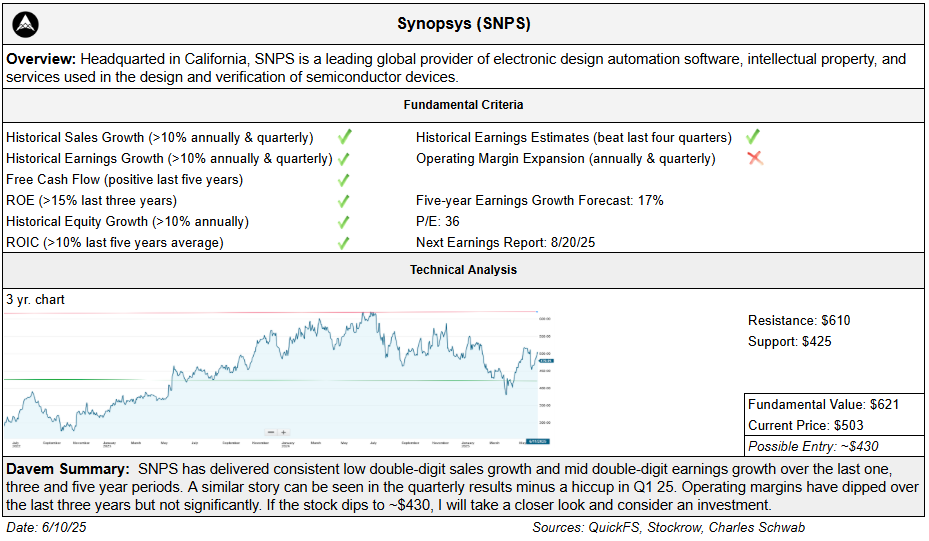
Recently removed Visa ($V) and Federal Signal ($FSS). Both good companies, but their recent growth numbers no longer meet my criteria.
The watchlist now stands at 36 quality companies.
When “Upgrading” Doesn’t Work Out
Started with a fictional story, ending with a real one.
Senior year of high school, I decided to try out for the golf team with very little experience and no formal lessons. I had to figure it out on my own. Learning to escape sand traps … talk about frustrating.
Somehow, I made the team. I certainly wasn’t the best player but I got to “practice” aka golf every day after school and even played in a few matches. I was pretty proud of myself for going for it.
After several more years of regular play, I improved enough to be fairly decent. And the best part of my game was my iron play. Pretty reliable and helped keep my scores respectable. Driving and putting on the other hand were a bit erratic.
Anyway, a few years ago I played a round with a friend who was good, I think he shot par that day. Late in the round, he glanced at my bag and said “You know, I think you could gain some distance and save a few strokes with some new irons.”
The rational me would have said “New irons? No thanks, that’s the best part of my game. Why would I mess with what works?”
The irrational me, “Yeah, these irons are like 15 years old, I think you’re right!”
So what happened next? I’m at Golf Galaxy, getting fitted and dropping $1,300 on some shiny new TaylorMade irons.
Now comes the part where I tell you how these new clubs transformed me into a scratch golfer, right?
Wrong.
The new irons look great in the bag but to this day I still haven’t figured out how to hit them consistently. What used to be my strength became a source of frustration. I went from regularly playing and enjoying golf to barely playing at all.
I traded something that worked just fine and produced results for something flashy that doesn’t work at all.
Sound familiar?
How many times do we do this with our investing approach? We have a strategy that produces steady results but then we fall victim to the marketing machine behind the latest hot trend or “revolutionary” system.
Most times we should just stay the course.
Cheers,
Andrew
Thanks for reading The Davem Dish! If you enjoyed this issue, feel free to subscribe and share it with other awesome people like you.
The content provided are personal opinions and presented for educational purposes only, as of the date published or indicated. Davem Advisors LLC is not a bank, licensed securities dealer, broker or investment advisor. Displayed returns are unaudited. Nothing stated constitutes a recommendation or advice as to whether any investment is suitable for a particular investor. You alone are solely responsible for determining whether any investment, strategy or service is appropriate for your objectives. Past performance is no guarantee of future results. Inherent in any investment is the risk of loss.