

Focus on the Right Information
Welcome to issue #5 of The Davem Dish. Every two weeks I share what actually works in investing based on my 20 years of wins, losses and expensive lessons. You’ll also get my thoughts on solopreneurship and life in general because the same principles apply — keep it simple, stay consistent and focus on what matters.
I used to have a corporate job where the main function was presenting quarterly risk reports to the C-suite. This was a big, bureaucratic organization with endless turf battles and political jockeying. The kind of place where five different departments do mostly the same work but where nobody admits or addresses it.
My manager would repeatedly state how we would stand out is by being more thorough — more “depth and breadth” in our reports. Executives would notice our effort and reward us with promotions and bigger bonuses.
Makes sense in theory.
But what actually happened?
We’d spend a ton of time preparing a detailed analysis, then more time preparing how to explain the analysis. But even with a summary, the reports would still be so long and detailed the executives couldn’t digest them. Not because they aren’t smart people but because with all their job responsibilities, they only had so much mental bandwidth for any single item.
Finally, in one meeting an executive said “There’s just too much to read here. I can’t explain this to the Board, nor do I want them asking questions at this level of detail. Can you just give me a visual one-pager to show what the risks are and what we’re doing about them?”
I tried to hide my smile.
Why? Because I’m a believer in simplicity. Especially for financial decisions.
We don’t need more information — endless analysis, opinions, and crystal ball predictions.
We just need the right information.
What Moves Stock Prices
Last issue, I covered the key financial metrics to look for in quality companies. But financial strength alone isn't going to move the stock price. You need a catalyst.
One of the most powerful catalysts? Quarterly earnings reports.
If you own shares, you’re looking for the beloved “beat and raise”, when a company beats expectations and raises future guidance. Almost a sure sign the stock will increase.
How do you know if this will happen? You don’t. But if a company has a recent track record of beating forecasts, then it's reasonable to assume they’ll continue. That’s why part of the Davem Method is to track Positive Surprises. Did the company beat earnings expectations over the last four quarters?
This is another indicator that management is delivering. Providing conservative guidance they can beat. Underpromising and overdelivering.
On the other hand, what happens when a company misses expectations? The stock usually drops and if you are a shareholder you’re not too happy. If it’s a big miss, then you have to evaluate if you still want to own the company.
But it’s not all bad news because misses can create opportunities.
I’ve seen this play out repeatedly. Analysts were expecting say 35% earnings growth from a quality company, but the company “disappoints” with only 30% growth. The stock drops. But 30% growth is outstanding and way above our minimum criteria. A quick analysis check may now show a discount to fair value. Couple that with a price pullback to a recent support level and we have a great buying opportunity.
This approach is straightforward and only takes a few minutes per company. You simply need to track earnings reports, watch the market reaction, and utilize the Davem Method to separate noise from opportunity.
Want to learn more specifics about the Davem Method? Check out my free guide Stock Selection Simplified.
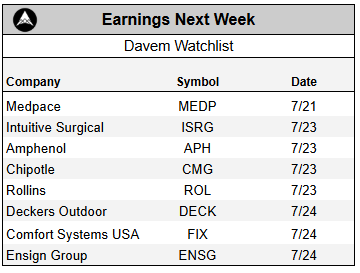
Earnings season is picking up and I will be watching my watchlist closely for opportunities to share. Here’s a list of Davem Watchlist companies reporting next week:
A Bit of Wandering: Why I Started Tracking Human Decency
My brother and I were hiking a popular trail recently when I noticed something odd. He was saying hello to everyone we passed, literally everyone. What caught my attention was less than half bothered to say hello back. I started counting. Yes, I’m that guy.
After a while I asked him “Why are you saying hi to everyone?” and he replied, “I don’t know, isn’t that just a nice, friendly thing to do?”
This made me curious enough to run my own little social experiment. During my neighborhood walks, I started tracking how many people returned a simple “hello”.
I’m not talking about the people buried in their phones, or neighborhood friends. I mean strangers who looked directly at me as we passed each other.
The results?
Less than 50% said hello back! No acknowledgement, no nod, just blank stares, like I was about to ask them for a donation.
Maybe I’m not a friendly looking person?
My experiment then extended to holding doors open. I don’t have to hold the door open for the person behind me, but I think it’s a nice gesture, so I usually do.
The good news is more than 75% of people acknowledge with a thank you (again I tracked). But the other 25% said nothing, just waltzed through like I’m their personal doorman.
My inner dialogue quickly turned negative.
What makes you so entitled that I have to hold the door for you? Did nobody teach you to acknowledge a nice gesture?
This could be another example of my inner curmudgeon emerging, but I can’t help but think basic courtesy is dying.
Have you noticed this too, or am I losing my mind?
Cheers,
Andrew
Thanks for reading The Davem Dish! If you enjoyed this issue, feel free to subscribe and share it with other awesome people like you.
The content provided are personal opinions and presented for educational purposes only, as of the date published or indicated. Davem Advisors LLC is not a bank, licensed securities dealer, broker or investment advisor. Displayed returns are unaudited. Nothing stated constitutes a recommendation or advice as to whether any investment is suitable for a particular investor. You alone are solely responsible for determining whether any investment, strategy or service is appropriate for your objectives. Past performance is no guarantee of future results. Inherent in any investment is the risk of loss.