

Why Chasing 10-Baggers Will Keep You Poor
Welcome to issue #10 of The Davem Dish. Every two weeks I share what actually works in investing based on my 20 years of wins, losses and expensive lessons. You’ll also get my thoughts on solopreneurship and life in general because the same principles apply — keep it simple, stay consistent and focus on what matters.
The hottest investing “advice” these days? How to identify the next 10 or 100-bagger. You know those magical under the radar startups or turnaround stocks that return 1,000% or even 10,000% and make you rich.
I get the appeal. Getting rich from minimal effort is everyone’s fantasy. “What if I had just bought $1k worth of Bitcoin in 2015? I’d be a millionaire now without lifting a finger and have the financial freedom to do whatever I wanted!”
Our brains are wired for these dreams. Whenever I buy a Powerball ticket, I start planning my purchases when I hit the jackpot. Maybe a ranch, maybe a boat, maybe a jet — maybe all three.
Do I design my life around inevitably hitting the Powerball jackpot? No, of course not, that would be insane.
So, why would you design your investment strategy around finding 10-baggers?
Tony Gwynn played professional baseball for 20 seasons and had a lifetime .338 batting average, the highest of any MLB player who began his career after World War II. He rarely struck out. In fact, he could have ended his career with 1,182 consecutive strikeouts and still maintained a career batting average above .300.
Arguably the best pure hitter of all-time, he hit occasional home runs but mostly singles and doubles.
This is the perfect investing analogy.
Building real wealth requires compounding returns over time. This means staying in the market long-term. Following a process to hit singles and doubles (returns of 15-30%). “Make contact” consistently and you’ll also hit the occasional home run.
But swinging for the fence every time? You’ll strike out and never build lasting wealth.
A few big losses will crush your portfolio and your confidence. Better to build wealth slowly than to gamble it away chasing the next Bitcoin.
Why CEOs Don’t Matter
CEOs are glorified. “Bet on the jockey, not the horse,” they say. For startups and turnarounds this has some truth. A visionary CEO might be the difference between success and failure.
But let’s test this theory with a recent high-profile example.
Brian Niccol joined Starbucks ($SBUX) after a successful run as CEO of Chipotle. You might remember the news. Huge pay package, lots of perks.
How is it going so far?
Quarterly results since Mr. Niccol took over in September 2024:
Q4 2024: Sales -0.3%, EPS -23.3%, ROE -47.1%
Q1 2025: Sales 2.3%, EPS -50.3%, ROE -41.5%
Q2 2025 Sales -3.8%, EPS -47.3%, ROE -34.4%
And how did the stock perform since his hiring? Down almost 4% while the S&P 500 is up 18%.
This is not to say Mr. Niccol is a poor manager or he won’t eventually lead the company back to profitability. But turning around a massive, struggling company is very difficult.
Does it make sense to tie up your capital hoping one person can work miracles?
Or does it make sense to invest in better opportunities elsewhere with less risk?
I invest in quality companies — businesses with demonstrated track records of consistent financial performance. It’s far more logical to forecast future growth from past results than to bet on someone’s ability to reverse years of decline.
“But in order to get rich in the stock market you need to have an edge, uncover information nobody else has and make bold bets”, you might say. “You can’t do anything with information that everyone else also has.”
Everyone may have the same information, but most people don’t know how to react appropriately at any given time. That’s where a disciplined, tested process creates an advantage.
You probably can’t name the CEOs of most of the companies on the Davem Watchlist. And when those CEOs leave? The company likely keeps performing — consistently growing sales and earnings, generating cash flow, making smart investments and ultimately creating more shareholder value.
That’s from the work of the collective organization, not one person at the top.
The Davem Method is a data driven approach. There’s no management criteria because it doesn’t really matter who the CEO is. What matters is that the company hits the numbers consistently and whether you know how to value the company, when to buy and when to sell.
Great companies with unheard of CEOs will outperform mediocre companies with celebrity CEOs every time.
Focus on the horse, not the jockey.
Want to learn more about how to pick winning stocks? Check out my free guide Stock Selection Simplified.
Davem Watchlist Insights
United States Lime & Minerals ($USLM) was added to the watchlist recently. The analysis? About thirty minutes.
It’s not about cutting corners but rather keeping it simple and focusing on what matters. Take a look at the snapshot below and let me know what you think.
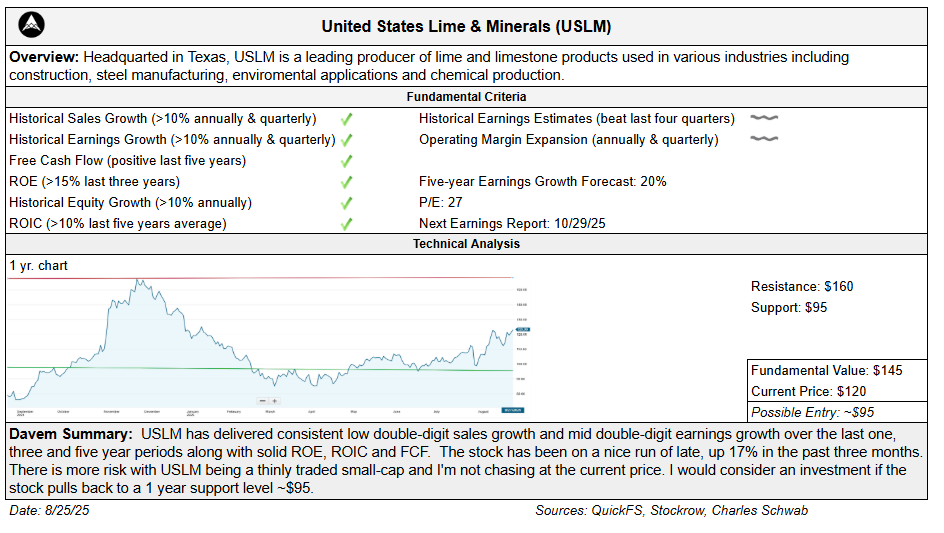
The watchlist now stands at 36 quality companies.
How to Not Lose Sleep Over AI
Lots of doomsday predictions circulating about how AI will ruin humanity.
I don’t remember these kinds of predictions when the internet was “taking over” but that’s a conversation for another day.
The real question is how do you thrive during massive change?
The old saying has never been more relevant — the only constant is change. To keep your sanity and succeed, you need to embrace it and make change work for you.
How do you become someone who thrives in uncertainty? By being adaptable.
Someone who possesses three things:
First, develop transferable soft skills. Problem solving, strategic thinking, creativity, leadership, communication, etc. These skills are highly transferable in any environment and are uniquely human.
Second, become a generalist. Don’t be a one trick pony. Build experience and expertise in multiple areas so you can draw connections others miss and innovate in unexpected ways.
Third, get comfortable with ambiguity. When there's no playbook, you’re able to create one and lead others through the unknown.
Change doesn’t have to be terrifying. It’s only scary when you’re unprepared or inflexible.
If you’re confident in your ability to learn, pivot and solve new problems, change becomes opportunity.
The future belongs to the adaptable. Not the ones hiding from change, but the ones running toward it.
Cheers,
Andrew
Thanks for reading The Davem Dish! If you enjoyed this issue, feel free to subscribe and share it with other awesome people like you.
The content provided are personal opinions and presented for educational purposes only, as of the date published or indicated. Davem Advisors LLC is not a bank, licensed securities dealer, broker or investment advisor. Displayed returns are unaudited. Nothing stated constitutes a recommendation or advice as to whether any investment is suitable for a particular investor. You alone are solely responsible for determining whether any investment, strategy or service is appropriate for your objectives. Past performance is no guarantee of future results. Inherent in any investment is the risk of loss.