

Are We Dancing on the Titanic?
Welcome to issue #9 of The Davem Dish. Every two weeks I share what actually works in investing based on my 20 years of wins, losses and expensive lessons. You’ll also get my thoughts on solopreneurship and life in general because the same principles apply — keep it simple, stay consistent and focus on what matters.
In the past few months there has been increasing talk about a market bubble.
Look around and the signs are everywhere:
Stocks are at all-time highs even with economic uncertainty.
A fresh new crop of meme stocks.
Money losing companies soaring with triple digit YTD gains.
Valuations are stretched. Just look at $PLTR with a P/E of 600.
Billions pouring into AI related funds run by investment managers with no experience.
Seems like a bubble right? Reminiscent of the dotcom days.
Maybe we’re in a bubble. Maybe we’re not. But here’s what nobody can answer. When will it burst?
Market timing is a fool’s game, but preparation isn’t. So, what should you do in this market?
If you’re sitting on 100%+ gains this year — congratulations. But do you have a plan to lock in profits?
How will you feel if you watch your 100% gain evaporate to zero, then turn into a loss? Because that’s exactly what happens when bubbles burst.
Institutional investors have risk mitigation strategies aimed at cutting losses short. So, when the tide turns, they will sell their positions and as the share price sinks, will you get out too?
Remember the original meme stocks, GameStop and AMC? They are down 74% and 99% respectively from their peaks in 2021.
The question isn’t whether we’re in a bubble. The question is — do you have an exit strategy before the music stops and there aren’t enough chairs?
Why Your Brain Is Your Enemy
There are countless tactical strategies for investing. But if you want long-term success, the most important thing isn’t which stocks to buy — it’s developing a resilient mindset that limits ego, emotions and bias when making decisions.
Emotions are part of being human. They make life interesting. But they’re kryptonite for investors.
You can’t just flip a switch and eliminate biases that have been hardwired into human brains over hundreds or thousands of years. That’s like telling an addict to “just stop”. Makes perfect sense and is easy to say but hard to do.
We can take profits too quickly on winners (disposition effect) while holding on to losers (endowment effect). These two biases alone can kill our returns and our confidence. Especially holding on to losing stocks.
So how do you manage your emotions? You develop systems. Disciplined processes for buying and selling.
We’re not gambling here. If you need a thrill and want to test your hunches, take a few bucks to the casino.
Let me take you through a real example.
A few weeks ago, I was monitoring Novo Nordisk ($NVO) after they cut guidance and the stock fell 28%. I ran through the Davem Method:
Historical financials — strong.
Future growth — still promising.
Stock trading near a 3-year low.
The information available at the time indicated a buying opportunity. I bought shares at $54.3.
What happened next? I was too early. The stock kept falling over the next few days and my stop loss order was triggered — a 12% loss.
How did this make me feel? Was I kicking myself for being early or missing the bounce that came days later?
Neither.
Sure, losing money isn’t fun. But I know from experience that occasional losers are inevitable. And I have a systemized process for cutting losses short — a key element for long-term sustainability.
Instead of stress and anxiety watching my investment crater while hoping for a miracle bounce, I knew exactly how much I could lose. I took a small hit, got my capital back, and moved on to other opportunities.
This wasn’t always my approach. I used to follow the popular advice — “Buy a good company and hold forever”.
But I found this doesn’t actually work that often. Even long-time great companies stumble or crumble. Look at GE or countless smaller companies that never recovered.
Case in point. Just a few years ago, a small Israeli company Perion Network met my criteria and was trading at a level where I thought I could earn my minimum 15% return. I bought shares and didn’t set a stop loss. Long story short, a string of negative events led to a nearly 70% share price decline and I held the entire way down. I would need a 200% increase just to break even. I finally threw in the towel at a 66% loss. Over a year later the share price has hardly moved.
There had to be a better way.
“Well duh” you might think, “that’s the risk of small, thinly traded stocks.”
Ok, so let's take a look at a recent example with a household name, UnitedHealth ($UNH).
In mid-April, UNH was trading near a 2-year support level of $450, down from a 52-week high of $630. A good time to buy perhaps.
The stock continued to slide and now trades at $309 (even with a 14% jump today) — a 31% loss. UNH will need to gain another 45% just to break even.
If you invested in this scenario, how would you feel? Anxious? Low confidence? Questioning your investing skill?
Wouldn’t you rather have a small loss and your capital back to deploy elsewhere?
This is why stop-losses aren't just about money — they're about psychology. Nobody wants to be wrong, but losses will happen. To stay in the market long-term, you need a process that minimizes both monetary losses and emotional damage.
Systems beat emotions every time. When you have clear rules for when to cut losses, you can invest with confidence instead of hope.
Want to learn more specifics about the Davem Method? Check out my free guide Stock Selection Simplified.
Davem Watchlist Insights
Let’s first look at monthly performance:
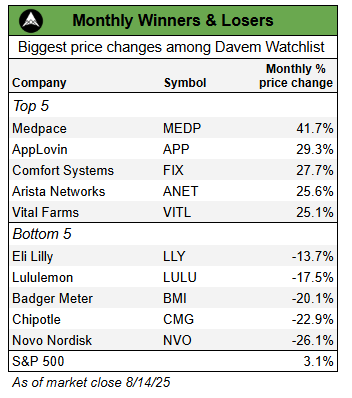
I’ve been watching $DAVE and $LLY over the past few weeks for entry points and added positions in both companies on August 11th. As of today, both are up about 10%.
A Bit of Wandering: Take Your Own Path
I enjoy mountain biking and occasionally ride with a friend who on the surface is similar to me. We’re about the same age, same build, we even have the same model bike.
Where the similarities end? The moment we hit our first climb.
I look up and he’s gone, leaving me in the dust, literally and figuratively.
The mental torture begins.
Why is he so far ahead? I feel like I’m pedaling and I’m not even breathing hard yet. I should try to catch up …
I’m not catching up, he’s further ahead. Now I’m breathing hard and he’s out of sight.
Why am I so slow? Why can’t I keep up!?
This narrative played out the first couple times we rode together until I came to the realization that I should just enjoy my journey.
We’re both going to make it to the top. I’m not holding him up. So why not just enjoy my own journey and pedal at my own pace?
(I’d like to think I can keep up with him slightly better on the downhills but that might be stretching the truth a bit.)
Starting a business can trigger the same mental spiral. It’s easy to compare yourself to others. That person is just like me — why are they further ahead? Why do they have more subscribers and more income?
This line of thinking can wreck your mental health.
The beauty of starting a business is you can do it your way. Sure, you can learn from others and aspire to their success. But the journey is uniquely yours.
What works for them may not work for you. You have to figure out your own path.
And that’s done by daily learning and iterating. What do I actually like doing that will be sustainable? What energizes me vs. what drains me? What feels authentic?
These feelings can change over time. What I don’t want to do today, maybe I’ll try in six months if it feels right.
Remember you are your own boss. You can follow your own rules and there are many different ways to build something meaningful.
Just keep pedaling.
Cheers,
Andrew
Thanks for reading The Davem Dish! If you enjoyed this issue, feel free to subscribe and share it with other awesome people like you.
The content provided are personal opinions and presented for educational purposes only, as of the date published or indicated. Davem Advisors LLC is not a bank, licensed securities dealer, broker or investment advisor. Displayed returns are unaudited. Nothing stated constitutes a recommendation or advice as to whether any investment is suitable for a particular investor. You alone are solely responsible for determining whether any investment, strategy or service is appropriate for your objectives. Past performance is no guarantee of future results. Inherent in any investment is the risk of loss.