

Meet Your Future; 65, Broke and Driving a Forklift
Welcome to issue #11 of The Davem Dish. Every two weeks I share what actually works in investing based on my 20 years of wins, losses and expensive lessons. You’ll also get my thoughts on solopreneurship and life in general because the same principles apply — keep it simple, stay consistent and focus on what matters.
There’s a guy at my gym pool I call “Speedo Guy” for obvious reasons. I don’t know his actual name but I know everything else about him — where he works (at a large brewery), where he used to work (airline ground crew), his health struggles. He’s one of those friendly older guys who shares his life story whether you asked or not.
Recently he was venting about his boss. I assumed that he was just working at this point to stay busy, so I asked, “How much longer do you want to keep working?”
"Till the day I die. Can't afford not to."
"But don't you have a pension from the airline?"
"Mostly wiped out when they went bankrupt, plus unpaid medical bills from my heart attack, and back rent. I’m living paycheck to paycheck and can't even afford to file for bankruptcy." He laughed. "They say there's light at the end of the tunnel — I can't see it."
Here's a guy who’s been working for a long time, and nearing retirement age yet he's still grinding just to survive.
What’s sad isn’t just that Speedo Guy is broke and struggling — it's that he never learned how to make his money work for him.
Your employer isn’t going to save you. That pension you're counting on? Ask United Airlines employees how that worked out.
The government isn’t going to save you either. Social Security? Good luck with that being enough to live on.
People think you need $100k to start investing. You don’t. You can start with $100.
While you’re waiting to have ‘enough’ money to invest, inflation was recently eating 7% annually and you’re not even getting started learning new skills. But sure, keep waiting.
The barriers are gone. No more commissions on trades and tax-advantaged accounts are easier to set up than ever.
The real barrier is in your head:
"I'll start when I have more money."
"I'll figure it out later.”
“I’ll trust a professional.”
Speedo Guy probably said the same things 30 years ago.
Start with what you have. Learn a process and use real money, even if it's small. Build the skills and mindset for financial freedom while you still have time to use them.
The alternative? Driving a forklift when you're 65 because you still need the paycheck.
Here’s what Speedo Guy didn’t know that could have saved him …
Why I Dropped Lululemon (After Making 93% in Profits)
Lululemon ($LULU)was dropped from the Davem Watchlist following last week’s earnings report. Their quarterly sales and earnings growth no longer meet my criteria. Simple as that.
What’s interesting is LULU is down -43% over the past five years while I’ve profitably invested in LULU three times during that same period for a combined +93% gain.
How? By not marrying the stock.
The Davem Method isn’t about finding companies to hold forever, although that can occasionally happen. It’s about identifying quality companies, calculating a fair value, spotting entry points where we can earn our minimum return, and knowing when to sell. And it works by removing ego, emotion and biases from investing decisions.
Three investments, same simple process:
Investment #1:
3/1/2021 Buy: $300 (support level)
12/13/2021 Sell $383 (trailing stop triggered)
28% gain in 9 months
----------------------------------------------------------------------
Investment #2:
3/5/2023 Buy: $300 (support level)
3/18/2024 Sell: $415 (trailing stop triggered)
38% gain in 12 months
----------------------------------------------------------------------
Investment #3:
9/23/2024 Buy: $265 (support level)
3/3/2025 Sell: $336 (trailing stop triggered)
27% gain in 5 1/2 months
----------------------------------------------------------------------
All short-term. Same company, same process.
Meanwhile, Buy and Hold investors are now down -43%, hoping for a miracle rebound.
This isn’t day trading. It’s not trying to time the market. It’s recognizing that even great companies go through cycles, and you can profit from those cycles repeatedly — if you have a disciplined approach.
But how do you spot these opportunities without spending hours on research?
Don’t Blindly Follow Old Rules When a New Game is Being Played
Last week I spent a few hours reading Microsoft’s annual report and listening to their latest quarterly earnings call. This is what serious investors are supposed to do right? Warren Buffett famously devoured annual reports and he’s a billionaire — the “best” investor of all time.
Want to know what I learned that actually mattered for making an investment decision?
Nothing.
I used to print annual reports at my corporate job and study in my free time. Then I realized something — every word in those SEC filings and earnings calls is scripted theater. I know because I fed information to the Investor Relations department at a Fortune 500 company.
Executives have coaches and media training. Their job isn't to inform you — it's to attract investors and make everything sound amazing.
Do you think a CEO will ever say "Our competitor is absolutely crushing us with better products"? Never. They'll spin it as an “opportunity”. Then five analysts will ask the same question five different ways and the CEO will dodge it five times with the same non-answer.
Even if real news drops on an earnings call, the stock has already moved before you can get your order executed.
Maybe equity analyst reports can help? These “summaries” are somehow longer and more jargon-filled than the reports they’re summarizing. And now with a few AI prompts, anyone can produce a report sounding like an equity analyst. Like we need more of that.
All of this “complexity” is by design. The financial services industry wants you to believe investing is too complicated for regular people. “You need us. Blindly trust our expertise and pay our fees.”
What actually moves stock prices is simple. Companies either grow sales and earnings or they don't. They either meet expectations or they don't.
Learning to value companies and knowing when to buy and sell is basic math and is not difficult. Anyone can do it.
Warren Buffett built his fortune when information was scarce. Today information is everywhere (and mostly free). Don’t blindly follow old rules, when a new game is being played.
The question is — would you rather spend hours decoding corporate reports, pay someone to decode it for you, or learn to find opportunities yourself? Your choice, but time is of the essence and nobody wants to end up like Speedo Guy.
Cheers,
Andrew
P.S. Here is how I analyzed $MSFT . It took me 30 minutes and told me everything I needed to know:
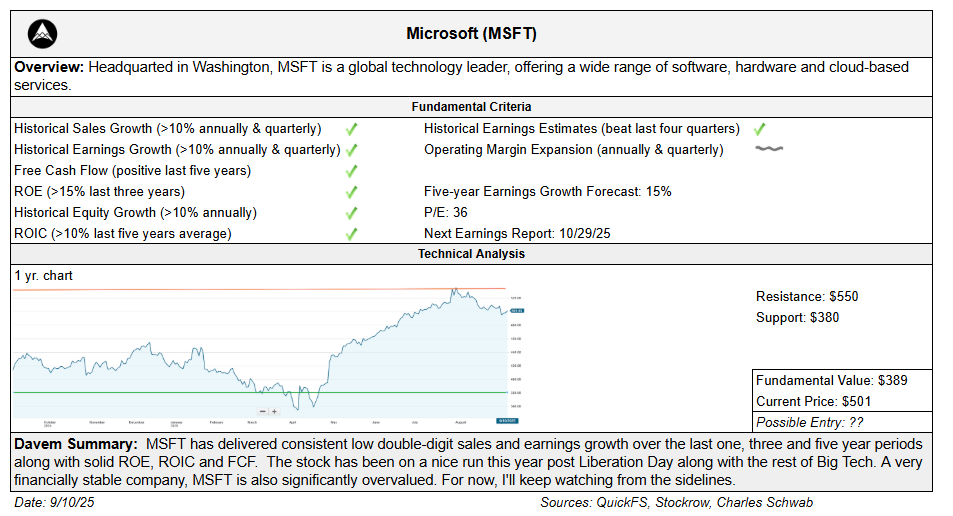
Want to learn more specifics about how the Davem Method can help you take control of your portfolio? Check out my free guide Stock Selection Simplified.
Thanks for reading The Davem Dish! If you enjoyed this issue, feel free to subscribe and share it with other awesome people like you.
The content provided are personal opinions and presented for educational purposes only, as of the date published or indicated. Davem Advisors LLC is not a bank, licensed securities dealer, broker or investment advisor. Displayed returns are unaudited. Nothing stated constitutes a recommendation or advice as to whether any investment is suitable for a particular investor. You alone are solely responsible for determining whether any investment, strategy or service is appropriate for your objectives. Past performance is no guarantee of future results. Inherent in any investment is the risk of loss.