

Are You Being Impulsive?
Welcome to issue #1 of The Davem Dish. Every two weeks I share what actually works in investing based on my 20 years of wins, losses and expensive lessons. You’ll also get my thoughts on solopreneurship and life in general because the same principles apply — keep it simple, stay consistent and focus on what matters.
Long-awaited, it’s finally here.
The newsletter I’ve been thinking about since I was an entry-level corporate employee with big ideas and no sense of workplace email etiquette.
Picture a younger me, excited about my new investing framework, decides to send an email about my newsletter idea to a few “trusted” colleagues. The response? An almost instant reprimand for misusing company resources. Oops, newsletter idea deflated.
The thing about good ideas, though, is that they don’t stay buried forever.
For almost two decades, I quietly continued working and fine-tuning my investing framework, what I now call the “Davem Method”. All while battling the nagging imposter syndrome voice:
“I’m not qualified to teach investing?”
Over time, I came to the realization that degrees and certifications are nice to have but what really matters is real experience and consistent results.
What will you get with The Davem Dish? No get rich quick schemes or jargon filled pontificating. Just simple, proven ideas and strategies to help you cut through the noise to make the kind of disciplined, unbiased decisions that actually build wealth.
I’m thrilled and honored you’re here. Now let’s dive into the inaugural issue!
Six minutes to buy a stock? Maybe that’s not so crazy after all
Last month there was a WSJ article discussing how new research from NYU showed the median individual investor only spends six minutes researching a stock before buying. And most of that time? Looking at the recent price chart.
Comments were as expected:
“You are being too kind to refer to them as investors. They sound more like gamblers. They should take their money to the casinos where they would have more fun and just as much luck.”
“This is why they call in "dumb money".
“I was taught you should spend zero time analyzing stocks. Since it's an efficient market, you can't possibly come up with any better analysis than the market”.
At face value, six minutes of research seems a bit reckless, but let’s dive deeper.
The researchers reached their conclusions by studying several hundred investors' clickstream data — basically following their digital breadcrumbs showing which websites were visited, in what order, and how long before making a trade.
It was unmentioned and certainly possible that these same investors spent previous time researching. Also, there was no mention of performance from these “impulsive” purchases, so no way of knowing if they were profitable investments.
This got me thinking — is there an optimal amount of time that should be spent researching stocks before a purchase? And how much time is enough?
At one extreme, you have the purists. The investors who spend dozens of hours dissecting annual reports, combing through analyst notes, interviewing company executives, customers, even suppliers. Certainly thorough, but is this even necessary?
At the other extreme, apparently some investors think a few minutes is enough.
The Davem Method is somewhere in the (lower) middle, specifically about 30 minutes to:
Screen for quality companies that exhibit financial strength based on a few key metrics
Analyze using a simple three-step process to determine a fair value price
Add to the Davem Watchlist, if the company passes the test
Making the watchlist doesn’t trigger an immediate buy. Instead, I watch daily price movements, waiting for the company to trade at a discount to fair value and at a level where I can earn my minimum required return.
When that happens? I’ll take a quick look at the price chart and buy — probably in under six minutes.
Now I’m wondering. Was my clickstream data included in this study?
How long do you spend researching a stock buy?
Davem Watchlist Insights
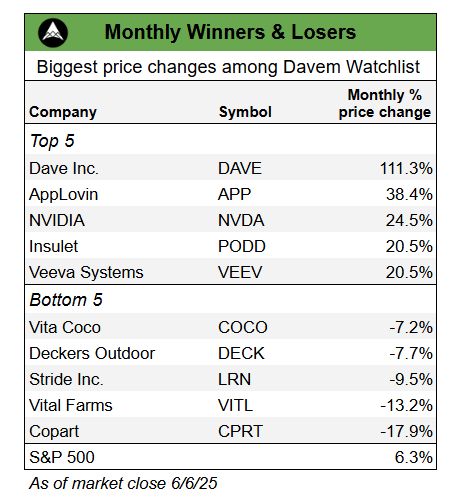
The Watchlist currently contains 35 companies that meet my quality criteria and have been analyzed with the Davem Method. Let’s take a look at last month’s winners and losers:
A Bit of Wandering: Jury Duty Dress Code — Apparently Optional
Was summoned for jury duty recently for the first time. Can’t say that I was excited, but maybe curious. Will this be like an episode from Law & Order?
The experience began in the security line with a shoeless man behind me. Now, I live in Colorado where the dress code is pretty loose so this guy could be a little down on his luck or a millionaire — hard to tell.
I glanced over at the security guard who looked slightly perplexed that someone would try to enter a courthouse with no shoes on. I passed through security and didn’t get to see their interaction.
As we all were finally herded to the meeting room, I couldn’t help but notice some of my fellow citizens' attire.
Pajama pants. Flip-flops. Baseball hats.
Look, I’m all for being YOU but we are about to enter a courtroom. In front of a judge. Has respect for institutions or ourselves completely disappeared?
The fact that this bothered me caught me off guard. When did I become the judge (pun intended) of courthouse attire. Maybe I’m reaching curmudgeon age.
After an hour of listening to seemingly everyone else's name get called to serve, I was dismissed. Random selection works in your favor sometimes. I thought of it more as a reward for dressing like a grown-up.
Cheers,
Andrew
Thanks for reading The Davem Dish! If you enjoyed this issue, feel free to subscribe and share it with other awesome people like you.
The content provided are personal opinions and presented for educational purposes only, as of the date published or indicated. Davem Advisors LLC is not a bank, licensed securities dealer, broker or investment advisor. Displayed returns are unaudited. Nothing stated constitutes a recommendation or advice as to whether any investment is suitable for a particular investor. You alone are solely responsible for determining whether any investment, strategy or service is appropriate for your objectives. Past performance is no guarantee of future results. Inherent in any investment is the risk of loss.