

The Stock Market is Rigged
Investor Deprogramming Series: Part V
Welcome to issue #20 of The Davem Dish. Every two weeks I share what actually works in investing based on my 20 years of wins, losses and expensive lessons. You’ll also get my thoughts on solopreneurship and life in general because the same principles apply — keep it simple, stay consistent and focus on what matters.
Part V of my Investor Deprogramming Series explores the question of whether the stock market is rigged. In this five part series I dove into “common wisdom” that may be sabotaging your wealth.
The Narrative That Won’t Die
Over the past four parts of this series, I’ve tackled the myths that keep people from investing successfully. The idea that nobody can beat the market, that the game is too complicated, that you should just buy and hold forever, and that you might as well hire a professional.
But there’s one belief that sits beneath all of them.
The stock market is a casino rigged by wealthy institutions and wealthy individuals. People like me can’t win.
And honestly, I get it.
In a recent Bankrate survey, more than 50% of investors said they believe the stock market is rigged against individual investors. That’s people actually invested in the market not fringe conspiracy theorists.
And for most of recent history, they were right.
The Era When It Actually Was Rigged
Let’s go back to where the narrative started and then a timeline of how it continued.
The 1980s: Greed Is Good (And Illegal)
“Blue horseshoe loves Anacott Steel.” Everyone remembers the cult classic Wall Street where Charlie Sheen’s character Bud Fox was feeding inside information to Gordon Gekko and living the high life with the ill-gotten gains. The movie wasn’t fiction though, it was based on real life.
The real Gordon Gekko was Ivan Boesky, who made $200 million betting on corporate takeovers. He seemed to know exactly when acquisitions were coming before anyone else did.
That’s because he was getting illegal tips.
In 1986, Boesky pleaded guilty to insider trading, paid a $100 million fine, and served 20 months in prison.
Boesky cooperated with prosecutors and helped take down Michael Milken — the junk bond king — who had supplied Boesky with billions in leverage to fuel his schemes.
This wasn’t an isolated scandal. Dennis Levine built a $12 million insider trading ring. His arrest led to Boesky and Boesky led to Milken. The whole thing eventually unraveled. Rudy Giuliani made a name for himself prosecuting the offenders and everyone went to jail — for a time.
The entire era was chronicled in James Stewart’s book, Den of Thieves. The title tells you everything and I highly recommend it if you haven’t read it.
The 2000s: Even Celebrities Cheat
In December 2001, Martha Stewart sold a few thousand shares of a small biotech company called ImClone.
One day later, the FDA announced it was rejecting ImClone’s cancer drug and the stock collapsed.
Stewart’s well-timed sale saved her a “whopping” $45,000. The scandal that followed cost her her reputation and her business empire hundreds of millions.
She wasn’t convicted of insider trading itself. She was convicted of lying about it and served five months in federal prison.
Martha Stewart wasn’t a Wall Street titan. She was a celebrity entrepreneur and a household name. And even she had special access regular people didn’t.
The narrative deepened.
2009: The Wiretaps
If the 1980s scandals felt like Wall Street cowboys playing fast and loose, Raj Rajaratnam’s fall felt like watching a criminal empire exposed.
Rajaratnam ran the Galleon Group, a hedge fund managing over $7 billion at its peak. His fund posted returns of 25-30% annually — the kind of numbers that are too good to be true for a hedge fund the size of Galleon.
The FBI decided to find out. For the first time in history, they used wiretaps to investigate insider trading and what they found was an extensive network. Rajaratnam had cultivated sources everywhere — IBM executives, McKinsey consultants, Goldman Sachs board members. He wasn’t exceptionally skilled at stock picking or even getting lucky. He was getting inside information.
In October 2009, Rajaratnam was arrested and eventually convicted of 14 counts of conspiracy and securities fraud. His sentence of 11 years in prison was the longest insider trading sentence in history at the time.
The judge said his crimes “reflect a virus in our business culture that needs to be eradicated.”
Twenty-five other defendants were charged and twenty-one pleaded guilty.
2013: The One They Couldn’t Catch
If you’ve watched the TV show Billions, you know Bobby Axelrod — the hedge fund titan who always seems one step ahead of the law and his nemesis, District Attorney Chuck Rhoades.
Bobby Axelrod is based on Steven Cohen.
Cohen ran SAC Capital, a hedge fund that posted returns of 25-30% annually for over two decades. (See the similarity with Galleon’s returns?)
At its peak, SAC’s trades accounted for 2% of all stock market activity. Cohen charged investors fees of 3% of assets and 50% of profits — far above the industry standard of 2% of assets and 20% of profits —and they paid happily because the returns were so good.
The question everyone asked was how?
By 2013, the FBI had their answer. Eight SAC employees either pleaded guilty or were convicted of insider trading. The most prominent was Mathew Martoma, a portfolio manager who received illegal tips about Alzheimer’s drug trials. Based on those tips, SAC made or avoided losing $275 million on a single trade.
SAC Capital pleaded guilty to insider trading. The $1.8 billion penalty was one of the largest fines in Wall Street history. The firm was forced to stop managing outside money and convert to a “family office” managing only Cohen’s personal fortune.
Cohen himself, though, was never criminally charged.
Prosecutors spent nearly a decade trying to link him directly to the illegal trades. They couldn’t prove he knew. He was banned from managing outside money until 2018, but he kept his $17 billion fortune. He bought the New York Mets in 2020 from Fred Wilpon for $2.4 billion. Ironic twist — Wilpon ran into financial difficulty prior to the sale, from among other things, a heavy investment in Bernie Madoff’s ponzi scheme.
The message was even when the government wins, some people are too big to truly lose.
2016: Golf, Gambling, and Stock Tips
Billy Walters was a legendary sports gambler and entrepreneur. For years, he also had a friend named Tom Davis who was on the board of Dean Foods, a Fortune 500 dairy company.
Davis would tip Walters about earnings, acquisitions, spinoffs. Walters made $43 million trading on inside information over five years.
Walters had another friend named Phil Mickelson, who he lent money to for sports betting.
Mickelson wasn’t as successful with gambling as he was golf and owed Walters nearly $2 million. In July 2012, Walters called Mickelson and urged him to buy Dean Foods stock.
Mickelson had never purchased Dean Foods before or any large stock purchase, for that matter. He bought $2.4 million worth.
A week later, the company announced a spinoff. The stock jumped 40%. Mickelson made $931,000 in profit and used it to pay back his gambling debt to Walters.
Mickelson was never criminally charged. He invoked the Fifth Amendment to avoid testifying. He paid back his profits and walked away while Walters went to prison for five years.
Yet another tabloid story people remember.
The Flash Boys Era
By 2014, the scandals weren’t even about breaking insider trading rules anymore, they were about the rules themselves.
Michael Lewis published Flash Boys and went on 60 Minutes to declare: “The stock market is rigged.”
His target was high-frequency trading. Algorithms that could see your order milliseconds before it executed and front-run it. Computers making thousands of trades per second, skimming fractions of pennies from every transaction.
The firms doing this had spent billions on faster fiber-optic cables, closer proximity to exchange servers, anything to shave microseconds off execution time.
One trader, Brad Katsuyama from Royal Bank of Canada, figured out what was happening and built a new exchange called IEX with built-in “speed bumps” to neutralize the advantage.
He famously confronted the president of BATS, a high-frequency trading exchange, on live television. When pressed on whether the market was rigged, Katsuyama said: “I believe the markets are rigged, and I also think you’re part of the rigging.”
This was different. The cheating was legal and the game was designed to favor insiders.
The Meme Stock Twist
Then came January 2021 and what’s now known as meme stocks. The first of which was GameStop.
For once, the little guys were winning.
Retail investors on Reddit noticed that hedge funds had shorted GameStop to absurd levels — more shares shorted than actually existed. Then they started buying and an epic “short squeeze” ensued. The stock went from under $10 in October 2020 to $483 on January 28, 2021.
Hedge funds who had shorted GameStop hemorrhaged money.
Melvin Capital — a fund that had averaged 30% annual returns — lost 53% in January alone. At one point they were losing more than a billion dollars a day. They needed a $2.75 billion emergency bailout just to survive but that wasn’t enough. Melvin shut down entirely in May 2022.
Hedge funds lost nearly $20 billion in January 2021. The little guys had beaten the house.
And then everyone’s favorite brokerage, Robinhood, shut down buying.
On January 28, at the peak of the frenzy, Robinhood halted buy orders for GameStop.
You could sell but you couldn’t buy. The stock collapsed and investors cried foul. Congressional hearings followed but nothing came of it.
Even when the little guy wins, they change the rules. Just like in a casino, the “house” always wins.
What Actually Affects You
I just took a trip down memory lane and walked you through a sample of 40 years of scandals.
And every single one of these stories reinforces the narrative that the market is rigged against regular people.
But here’s the thing: None of these scandals actually affected you.
Think about it.
Ivan Boesky made $200 million trading on merger tips. Who was on the other side of those trades? Other institutional investors — not you.
Raj Rajaratnam’s network was feeding him tips about Goldman Sachs board decisions and pharmaceutical trials. The trades he made based on those tips? They were against other professional traders moving billions of dollars. Not your IRA.
Steven Cohen’s SAC Capital was front-running earnings announcements with inside information. Their counterparties were other hedge funds, mutual funds, and institutional investors. Not the “little” person buying 100 shares of Apple for their brokerage account.
Even high-frequency trading — the “rigged” system from the Flash Boys story primarily takes money from institutional traders making massive orders. When you buy 100 shares of Apple, the HFT guys might skim a fraction of a penny. Is this meaningful to your returns? Not really.
There will always be people who don’t follow the rules. That’s true in every market, industry, and human endeavor. Some of them will get caught and go to jail, some won’t, and some will get a slap on the wrist and buy a baseball team.
But their cheating isn’t what’s holding you back.
What The Old Days Looked Like
The “rigged” narrative wasn’t just about scandals. It was also about access and for most of market history, access was genuinely unequal.
Trading Costs
Before May 1, 1975, the New York Stock Exchange set fixed commissions. Everyone paid the same and it wasn’t cheap.
In 1988, Charles Schwab charged a $39 minimum plus 1.6% of the transaction for telephone orders. Buy $5,000 of stock and you’re paying $120 in commissions. Round-trip cost to get in and out was nearly 5% of your total investment.
In the 1990s, online brokers brought costs down to $40 per trade. Still expensive for small investors.
Today it’s zero.
Trading costs went from $200 per trade in the 1980s to zero (not to mention easy internet access). That’s not a small change.
Information Access
Before October 2000, companies routinely gave material information to analysts and institutional investors before the public got it. Earnings previews, strategic plan — the inside track.
If you were Peter Lynch or Warren Buffett, you could visit management in person and ask questions nobody else got to ask. That was the edge — personal relationships and access.
Regular investors got the information late or not at all.
Then came Regulation FD (Fair Disclosure). The SEC mandated that any material information disclosed to analysts had to be disclosed to everyone simultaneously.
SEC Chairman Arthur Levitt said the rule was necessary to “level the playing field.”
Today, every company filing is available for free. Everyone has access to the same information.
The World You Live In Now
Let me visually show you what's changed:
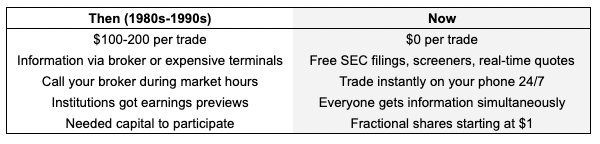
The barriers that made the market genuinely unequal are gone.
There has never been a better time in history to be an individual investor.
So why do more than 50% of investors still think it’s rigged?
The New Trap
Because a new form of “rigged” has taken its place.
It’s not Wall Street insiders or high-frequency traders. It’s the gamblifcation of everything.
For a lot of people, especially younger generations, gambling doesn’t feel reckless, it feels rational.
Look at the math.
Boomers bought homes at 4.5x their annual income. Today that number is 7.5x — higher than the peak of the 2008 housing bubble.
In 1989, when the youngest Boomer turned 25, their generation already held 20% of all U.S. household wealth. When the youngest Millennial turned 25 in 2020 it was just 5%.
The traditional paths — save diligently, buy a home, and watch your wealth compound feel blocked. Add to it the stress of student loan debt, the perception you’re behind, wages that don’t keep pace and AI threatening to eliminate the jobs that remain.
When the slow-and-steady approach your parents used looks like a fantasy, what do you do?
You swing for the fences. You look for the 100-baggers and the next NVIDIA. You gamble.
And now the casino lives in your pocket.
Sports betting used to require a trip to Vegas. Now it’s an app on your couch. Parlay bets — where you chain multiple wagers together for bigger payoffs and worse odds — are the fastest-growing segment.
Options trading used to require a broker and real money at risk. Now you can buy options with a few taps. In 2016, same-day options were 5% of S&P 500 options volume. By 2023 they were 43%. Options have a function but same-day options trading is not investing. It’s a slot machine with a stock ticker.
You can bet on elections, if it will rain today, or what country gets bombed next and when.
Everything becomes a bet.
And when everything in your financial life feels like a gamble — housing, jobs, the economy itself — then actual gambling and actual investing start to blur together.
Sports betting. Crypto. Meme stocks. Prediction markets. Options.
They all look like ways to “play the market”. Ways to (maybe) get ahead. And if you lose you just say, “It’s all rigged anyway, I wasn’t supposed to win”
But what the gamblification mindset misses is that these things are not the same.
In a casino, the house always has the edge over time. The longer you play, you’ll eventually lose.
In sports betting, you might hit a parlay here and there, but you’ll never win consistently over time.
In crypto and meme stocks, you’re betting on sentiment shifts and greater fools. There’s no real underlying value — just a game of musical chairs where someone ends up without a seat.
These are all negative-sum or zero-sum games.
The One Exception
But the stock market is different.
When you buy shares of a real company, you own a piece of something that generates actual value — profits, dividends, cash. The company works for you whether or not someone else shows up to buy your shares tomorrow.
Over time, the stock market isn’t a casino. It’s a wealth-creation engine. The S&P 500 has returned roughly 10% annually over the long term. Not from speculation, but because the underlying companies grew earnings.
You can actually have an edge here.
Not because you’re smarter than Wall Street professionals or because you have inside information. But because you can do something most investors consistently fail to do:
Manage your own behavior.
You can buy shares of quality companies at reasonable prices, let your winners run, and cut your losses short — following a process instead of your emotions.
The odds, for once, can be in your favor.
This is the escape hatch. The one game where the math can work for the individual investor.
But only if you treat the market like investing instead of gambling.
What’s Actually Rigged
The system is in many ways harder than it was a generation ago. The paths that worked for your parents are narrower now.
And in that environment, gambling feels rational. Swinging for the fences feels like the only move.
But when you bring the gambling mindset to the stock market — the one place where you can actually win — you turn an edge into a coin flip. You buy randomly, sell emotionally, chase hot tips, and panic at drawdowns.
And then you conclude, with perfect logic given your behavior, that the game is rigged.
What’s actually rigged is your beliefs.
If you believe you can’t beat the market, you’ll make decisions that confirm it.
If you believe you can beat the market — and build a process to do it — you will.
You’ll take out the guesswork. You’ll know what to buy, when to buy, and when to sell.
You don’t need tips, special access, or luck.
You need a real process and there’s no better time to start than today.
In Closing
Over this five-part series, I’ve tried to deprogram the myths that keep smart people from investing successfully:
Part I: The professionals don’t beat the market and they’re not trying to help you
Part II: Market complexity is manufactured to keep you dependent
Part III: “Nobody can beat the market” is a false narrative fed by the financial services industry to keep you beholden
Part IV: “Buy and Hold” isn’t a strategy. It’s the absence of one
Part V: The market isn’t rigged against you. Your beliefs are
The common thread? Every one of these myths keeps you passive, paying unnecessary fees, and believing you can’t do this yourself.
You can.
Not by developing a secret formula but by building a simple process. Focusing on what you can control and treating investing like a craft, not a lottery ticket.
Cheers,
Andrew
If you're ready to find out what's actually holding you back, I built a free 3-minute assessment that might surprise you.
This concludes the Investor Deprogramming Series. Thanks for reading all five parts. If any of this resonated, I'd love to hear which myth hit closest to home. Leave a comment and let me know!
Thanks for reading The Davem Dish! If you enjoyed this issue, feel free to subscribe and share it with other awesome people like you.
The content provided are personal opinions and presented for educational purposes only, as of the date published or indicated. Davem Advisors LLC is not a bank, licensed securities dealer, broker or investment advisor. Displayed returns are unaudited. Nothing stated constitutes a recommendation or advice as to whether any investment is suitable for a particular investor. You alone are solely responsible for determining whether any investment, strategy or service is appropriate for your objectives. Past performance is no guarantee of future results. Inherent in any investment is the risk of loss.