

Welcome to issue #44 of The Davem Dish. Every week I share what actually works in investing based on my 20 years of wins, losses and expensive lessons. You’ll also get my thoughts on solopreneurship because the same principles apply — keep it simple, stay consistent and focus on what matters.
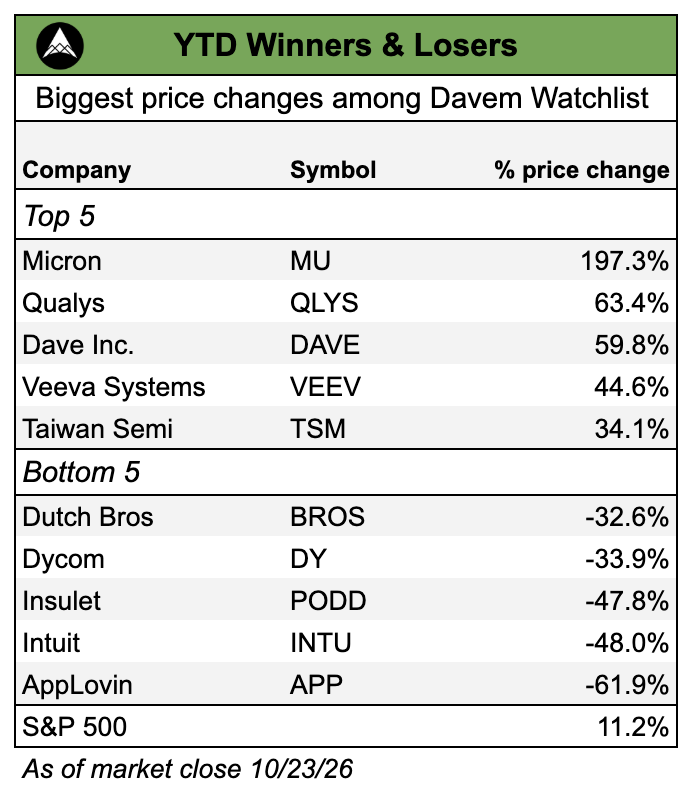
Third quarter earnings season is in full swing, which makes it a good time to check in on the Davem Watchlist. The chart below shows the five biggest winners and losers on the list so far this year, and the spread is wide, even though every one of the companies earned its spot on the list by passing the same screens.
Before getting into what drove those results, a quick refresher on what the watchlist actually is.
What the Watchlist Is (and Isn’t)
There are different types of watchlists — I keep one for bitcoin, gold, AI stocks, and other speculative companies, and you may have one with companies someone else recommended — but neither is the kind of list I use to make investment decisions.
The Davem Watchlist is a live list of roughly three dozen quality companies — businesses with a track record of growing sales and earnings, strong returns on capital, and real free cash flow. Every one of them has a fair value estimate, a margin of safety level, recent support levels, and one of three statuses: Overvalued (patience), Undervalued (watching for the right price), or Opportunity (conditions to buy are aligning).
What it doesn’t do is tell you exactly what or when to buy. It isn’t an ETF I buy at the beginning of each year, and it isn’t a list of predictions. Making the list means a company has earned the right to be waited on. That’s all.
This year’s bottom five illustrates that point. AppLovin and Intuit both sit on the watchlist, and both are down roughly 50% or more. A great business bought at the wrong price can still cost you half your money, and being on a list of quality companies doesn’t change that math. I learned a smaller version of that lesson with AppLovin this year, which I’ll get to below.
So why bother maintaining one? Because the edge for an individual investor lives in the watching. When a narrative turns, quality companies get mispriced, sometimes for a few weeks or a few months and sometimes for a single afternoon. If you’ve already done the analysis, you recognize the gap quickly and act. If you haven’t, you spend that window reading headlines and trying to figure out whether a 30% drop is a gift or a warning, and by the time you’ve decided, the price has usually moved. I check the list every day, it takes a few minutes, and most days I do nothing. That boring routine is the whole point.
Same Industry, Opposite Directions
Look closely at the chart and several of the biggest winners and losers are in the same industry — they sell software.
Software was the most punished corner of the market earlier this year with the so-called SaaSpocalypse and the fear that AI agents will make traditional software obsolete. All four of the companies noted below started 2026 under the same cloud. Veeva was down roughly 30% by April. Now, Qualys is up 63% YTD and Veeva 45%, while Intuit is down nearly 50% and AppLovin 62%.
What happened?
Qualys kept beating expectations, four straight quarters of earnings surprises, and in August it beat again and raised full-year guidance on both revenue and earnings. The stock jumped double digits that day as investors leaned into the idea that AI creates more security work, not less. With more than 10% of its shares sold short at times this year, some of that buying likely came from short sellers covering their bets, which can add more fuel to a move higher.
Veeva builds specialized software for the life sciences industry, a heavily regulated niche that’s much harder for a general purpose AI tool to replace. Analysts started making that argument in the spring, the company kept posting mid-to-high teens revenue growth, and management repositioned Veeva as an “application and AI agent company.” The stock rallied more than 50% from the end of June through September.
Intuit gave the market evidence instead. The company announced it was cutting 17% of its workforce in May, then in August guided 2027 revenue growth to 10%, down from 14%. The CEO admitted Intuit had lost DIY tax customers to cheaper competitors and that price was now the number one reason customers leave TurboTax. At its worst, the stock was down about 55% for the year.
AppLovin gained more than 700% in 2024 and over 100% in 2025, so expectations were sky high. In February, fears that Meta could compete in its core mobile gaming ad market knocked the stock down 16% in a day. In its second quarter report, the company missed its own guidance midpoints for the first time since going public, triggering a wave of downgrades. Add a securities class action questioning its AI growth claims, and the stock just hit a new 52-week low.
What Actually Separated Them
The SaaSpocalypse narrative hit all of the software companies. What decided where each one ended up was whether the numbers confirmed the fear or contradicted it. Qualys and Veeva kept beating and raising, which chipped away at the story one quarter at a time. Intuit and AppLovin handed the market a reason (a guidance cut, a miss) and the selling had something concrete to stand on.
The second factor was the starting point. AppLovin came into 2026 after a big run, which leaves very little room for a stumble. When a stock is priced for perfection, a merely good quarter reads as bad news.
This is the pattern I see play out over and over — the narrative moves first, and the numbers decide whether it sticks. It’s also why the watchlist matters more in a year like this one. Intuit is down by half, and the question I have to answer is whether that’s a mispricing or a reset, which a scary headline can’t tell me. Its new growth guidance sits right around my minimum threshold, so it’s on a short leash. Another slow quarter and I’ll likely remove it from the watchlist. A 50% drop doesn’t automatically mean a 50% discount. Sometimes it means the company is worth less than it used to be.
Does My Process Even Work?
Now for the investments that put the process to the test.
I bought Dave in August of last year at $181. A few months later, my trailing stop triggered and I sold at $228, a gain of roughly 25%. That cleared my 15% minimum required return, I was happy with the outcome and I moved on.
After I sold, Dave kept falling, all the way down to about $152 by early February, roughly 33% below where I got out. Then it took off, climbing to $458 by late July, almost exactly double my exit price. It closed on Friday around $355, up about 60% for the year and third on the watchlist’s winners list.
That hurts, right? A buy and hold investor who bought when I did and trusted their conviction would have been sitting on a gain of around 150% at the July peak, and they’d still be up close to 100% today.
But play it forward from the day I sold, without knowing what came next. All I knew was that the price had reversed enough to trigger my exit. The “conviction” investor had to hold through the next three months as their gain disappeared entirely and the position fell about 16% below what they paid for it, with no way of knowing a recovery was coming. And since the July peak, they’ve watched about 22% evaporate again. Conviction looks great in hindsight on the stocks that came back. The ones that didn’t come back don’t get written about.
And most don’t come back. According to Hendrik Bessembinder’s research, close to 60% of stocks reduce shareholder wealth over their lifetimes, and past winners only keep outperforming about 30% of the time. Holding Dave through a 33% drawdown worked out this time. Holding through drawdowns as a rule is how portfolios get wrecked.
If Dave is the investment where the process cost me upside, AppLovin is the one where it kept a mistake small. Back in August I sent an Opportunity Alert on AppLovin after its post-earnings selloff and disclosed my position: bought at $310 on August 12, at half my normal size because the stock was still in a clear downtrend with no confirmed base, and a stop loss 12% below my entry. I was wrong about the entry price and the stock didn’t bounce. In fact, it kept sliding, the stop triggered, and I sold at $271 for a loss of about 12.6%. Because I’d sized it at half, the hit was roughly equivalent to a 6% loss on a normal position. AppLovin set a new 52-week low around $258 last week. Without the stop I’d be down roughly 17% and counting, with no idea where the floor is, and I’d be telling myself the same story every conviction investor tells: the fundamentals are fine, and the market just hasn’t figured it out yet.
Put the two investments side by side and you have the whole method in a nutshell. It was never designed to capture every 100% run. It’s designed to lock in profits above my minimum, keep any single position from blowing up the portfolio, and do that consistently across hundreds of decisions. Over my last 100 investments, about 65% were profitable. The price of that protection is that sometimes I leave a big run on the table, and Dave is the best example I have this year. There will probably be another example next year. I’ll accept that tradeoff every time, because I don’t know whether a stock will go up 100% or down 50% after I sell, and neither does anyone else.
Selling also didn’t end the relationship. Dave never left the watchlist, which means the same process that got me out can bring me back in at the right price.
So does the process work? Yes. On Dave I booked a profit above my minimum required return, and on AppLovin I took a small, pre-defined loss instead of a potential big one. Both times my capital was free to go to work elsewhere. The scoreboard that matters is the whole portfolio over years, not one company’s best-case scenario.
Get the Watchlist
The full Davem Watchlist is free for every newsletter subscriber. It's a live Google Sheet with roughly three dozen quality companies, each with a fair value estimate, margin of safety level, support levels, and its current status, updated continuously. Subscribers also get opportunity alerts when conditions start aligning.
Earnings season is when narratives turn and quality companies get mispriced. Having the list in hand before that happens is the whole advantage.
Cheers,
Andrew
The content provided are personal opinions and presented for educational purposes only, as of the date published or indicated. Davem Advisors LLC is not a bank, licensed securities dealer, broker or investment advisor. Displayed returns are unaudited. Nothing stated constitutes a recommendation or advice as to whether any investment is suitable for a particular investor. You alone are solely responsible for determining whether any investment, strategy or service is appropriate for your objectives. Past performance is no guarantee of future results. Inherent in any investment is the risk of loss.