

Being Right Is Overrated
Welcome to issue #35 of The Davem Dish. Every week I share what actually works in investing based on my 20 years of wins, losses and expensive lessons. You’ll also get my thoughts on solopreneurship and life in general because the same principles apply — keep it simple, stay consistent and focus on what matters.
A post similar to this pops up on my feed almost daily.
“If you'd bought Amazon at the IPO in 1997 and held, $10,000 would be worth roughly $37 million today. All you have to do is identify great companies, ignore price volatility, and hold forever.”
The implication is that picking stocks isn’t really that hard and look at what you missed by being impatient. The person probably didn't buy Amazon in 1997 either but is selling you the feeling that you should have.
When you read these posts, what is your first thought? Regret. Envy. Fear?
Maybe you start thinking, “I need to find the next Amazon, or Microsoft, or NVIDIA because that would change everything.”
That emotional pull is what the expert prediction industry runs on. The belief that being right about the winner is what makes people wealthy.
The math points the other way.
Why We Love Predictions
Uncertainty is uncomfortable and our brains have evolved over thousands of years to hate it. Not knowing what happens next used to mean not knowing whether to run or fight, or eat or sleep, and survival depended on moving fast. So we developed a strong preference for certainty, and a confident answer from an authority figure feels better than an honest “Well, it depends”.
The stock market is one of the most uncertain environments a person can voluntarily enter and that uncertainty is uncomfortable when your retirement or your kids’ college fund is riding on it. When someone shows up offering certainty — a specific target, a guaranteed prediction, a “this is the next Amazon” — you buy the prediction because it feels better than sitting with the uncertainty. You’re paying for emotional relief. What you’re missing is the statistical improbability that you’ll ever actually make money from it.
The thing is if you own an S&P 500 index fund, you already own Amazon. It entered the index in November 2005 and has been in your fund ever since. Split-adjusted, you captured the run from around $2.40 per share to around $280 today, more than a 100-fold gain over the last two decades, captured inside your index fund with no research and no need to be right about anything.
You also own NVIDIA, Meta, Alphabet, Microsoft, and every other winner the market produces. The index fund captures them automatically when they get big enough to matter.
The Amazon chart from 1997 to today shows the lottery version of a wealth story. The version where you picked the winner in your garage with a shoestring brokerage balance, held it through a 95% drawdown during the dot-com crash, held through a drawdown of more than 50% in 2022, and never sold. That version requires you to have never needed the money for a life expense and to have been right about a decision made in 1997 and to have stayed right about it for 29 years across every scary market event along the way.
The wealth is already yours through the index fund. What the “if you’d bought” post is really selling you is the ego reward of being the person who called it. The one who knew when nobody else did.
The market expert industry is built on selling it.
The Hold Forever Myth
The first part of the prediction game is what to buy. The other part is the hold forever myth.
Neither survives the research.
There’s the widely cited research from Hendrik Bessembinder, whose latest study analyzed nearly 30,000 stocks from 1926 through 2025 and found only 1,100 companies (less than 4% of stocks) accounted for all the net wealth created by the US stock market over a century. The other 96% collectively matched cash.
If that weren’t enough, almost 59% of stocks reduced shareholder wealth over their lifetime, meaning nearly six in ten investments were losers.
On the other side, the top ten stocks — Apple, NVIDIA, Microsoft, Alphabet, Amazon, Broadcom, Exxon Mobil, Meta, Tesla, and Walmart — generated roughly 29% of the $91 trillion in shareholder wealth since 1926. A tiny handful of extreme winners carried the entire market.
A buy and hold strategy for individual stock picking is essentially a bet you can identify one of the 4%. The odds are heavily stacked against you.
And then, contrary to what many say, winners don’t keep winning. Dimensional Fund Advisors ran the data and found that of stocks that outperformed the market over the previous 20 years, only about 30% continued to outperform over the following 10 years. Of stocks that underperformed over the previous 20 years, roughly 30% subsequently outperformed. A past winner and a past loser had the same odds of being a future winner. Being a past winner told you nothing about what came next.
So the investor who buys the “next Amazon” and holds forever is playing a game with two dismal probabilities stacked on top of each other. First, a small chance of correctly identifying one of the 4% that matter. And second, if they do pick correctly, there’s only a 30% chance that past outperformance continues.
What the Psychology Costs You
The market doesn’t operate on logic and knowing the odds though. It operates on emotions, and the emotional experience of being right feels like winning. And that ends up warping your entire decision-making structure in ways that cost you money regardless of how good your picks are.
Two behaviors are common and both come from the same emotional root.
The first is holding losers too long. When a position moves against you, selling means admitting you were wrong. You bought at $100, it’s at $80, and closing the position converts a paper loss into a documented 20% mistake. So you hold, waiting for the bounce, telling yourself the thesis is still intact, refusing to accept that this position isn’t going to work.
“I’ll never make generational wealth by selling now, right?”
The second is selling winners too early. When a position moves in your favor, closing it locks in the feeling of having been right. Nobody can take that from you now, so you sell at +15% gain instead of capturing a +40% run or higher, because +15% in your pocket is a certified win and leaving the position open leaves the possibility that the stock reverses and takes away your feeling of victory.
Both behaviors make sense if you’re optimizing for the emotional experience of being right. Both are irrational when you run the numbers.
The Math That Compounds
Let’s make this concrete with a simple example.
Say you make ten investments over the course of a year, each starting with $10,000. That’s $100,000 total deployed, inside a tax-sheltered account. You’re right on four and wrong on six. A 40% hit rate, worse than a coin flip, with a “hit” meaning you closed at a profit. The hit rate stays the same across all three scenarios below. What changes is the exit discipline on winners and losers.
Scenario 1: Losses cut, winners run
You close losers at -12% using stop orders. You let winners run to an average of +40% using trailing stops.
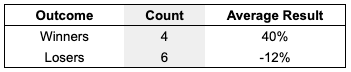
Ending portfolio: $108,800
Return: +8.8%
Wrong more often than right, but still making money.
Scenario 2: Losses held
Same four winners at +40%. When a position moves against you, you hold. You give the thesis time to recover. You close the losers at -40%.
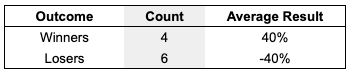
Ending portfolio: $92,000
Return: -8%
Same picks and hit rate. Letting the losers run cost you $16,800 compared to Scenario 1.
Scenario 3: Winners cut early
12% loss cap holds. But you sell winners at +15% to lock in the gain before it slips.
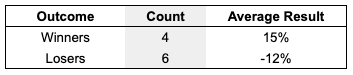
Ending portfolio: $98,800
Return: -1.2%
Same picks again. Cutting winners early cost you $10,000 compared to Scenario 1 and turned a winning year into a losing one.
Reading the Scenarios
The hit rate was 40% in every case. Scenario 1 made money on a losing hit rate. Scenario 2 lost 8% on the same picks. Both outcomes are explained entirely by the exit rules.
Market experts telling you to hold, to trust the thesis, to have conviction, to be patient if the fundamentals haven’t changed — those instructions all fall on the losing side of Scenario 2. The words sound like wisdom, but they don’t hold up to reality.
Recovery math is unforgiving. A 50% loss requires a 100% gain to break even. A 70% loss requires 233%. Positions can climb out of holes like that, but the odds are stacked so heavily against it that your capital is better deployed elsewhere long before you find out.
Whether you build wealth or destroy it is what happens when you’re wrong. Even a losing hit rate compounds when the losses stay small and the winners run. And we’re not even talking about “big” winners, just your average wins.
A single year of results is easy to shrug off. Compounding over a longer duration is where the exit rules turn into real money.
Assume each scenario’s annual return holds steady for 10 years on a $100,000 starting portfolio. Here’s what happens:
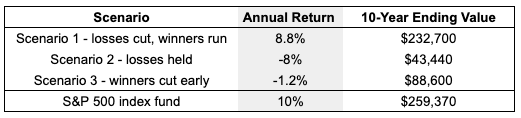
It’s pretty clear what happens when you cut losses short and let winners run. The interesting part is comparing Scenario 1 to the S&P 500. Even with disciplined exits, you only get roughly market returns, which raises the question — if you’re picking individual stocks and landing at market performance, why even bother?
Stock picking demands time, attention, research, emotional discipline, and a tolerance for volatility that index fund investing doesn’t. If the reward for all that effort is just matching the S&P 500 return, the effort isn’t worth it. You could just buy an index fund automatically each month, spend zero hours on your portfolio, and hit the same number. Picking individual stocks only makes sense if you have a real, sustainable edge over the market.
What a Better Hit Rate Gets You
Every investor will be wrong some of the time, that’s not in question. But what if you’re wrong less often and can beat a 40% hit rate? This is possible with a process — only buying quality companies at a discount to fair value, at support levels, with a defined margin of safety. This filter eliminates most of the picks that would have failed. Over my last 100 investments (that’s going back more than a decade), my hit rate averaged 65%.
Applied to the same Scenario 1 example, a 65% hit rate looks like this:

Ending portfolio: $121,800
Annual return: +21.8%
Over 10 years, here’s how that stacks up against the earlier scenarios:
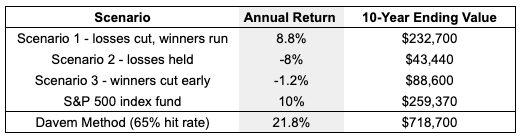
The buying discipline from my method pushes the ending portfolio to nearly three times the S&P 500’s outcome.
That’s the payoff for putting in the extra work.
If you want to learn the exact Davem Method — the quality screen, entry criteria, and exit rules — my Stock Selection Simplified guide walks you through all of it, with templates you can use for any company.
Where the Returns Come From
The best investors aren’t always right. They just manage their exits. That’s the piece the market expert industry doesn’t sell, because it’s not very marketable. There’s no way to package “be wrong 40% of the time but keep the losses small and let the winners run” into a viral post.
The boring version actually compounds over time and the truth is many investors are still playing for the ego reward. Falling for the once in a lifetime lottery pick stories and holding losers because closing them means admitting a mistake.
You already own Amazon, NVIDIA, and whatever the next hit stock turns out to be through the index fund that doesn’t ask you to be right about anything. What you don’t own yet is a process that keeps the emotional accounting from wrecking your portfolio when you add individual positions on top.
The market expert on television, the finfluencer on your feed, the guru on the podcast — they’re all selling the same product. Certainty with a prediction of what to buy and the feeling of being the one who called it.
That feeling ends up costing you more than you think.
Cheers,
Andrew
Thanks for reading The Davem Dish! If you enjoyed this issue, feel free to subscribe and share it with other awesome people like you.
The content provided are personal opinions and presented for educational purposes only, as of the date published or indicated. Davem Advisors LLC is not a bank, licensed securities dealer, broker or investment advisor. Displayed returns are unaudited. Nothing stated constitutes a recommendation or advice as to whether any investment is suitable for a particular investor. You alone are solely responsible for determining whether any investment, strategy or service is appropriate for your objectives. Past performance is no guarantee of future results. Inherent in any investment is the risk of loss.